Why Raw Pit Notes Beat Polished Sponsor Fluff on the PR Desk
A three-sentence, bulleted mechanical update from the pit area outperforms a multi-page corporate marketing release every single time. When compiling the latest news for a weekly Northeast dirt-track digest, editors work under tight turnaround windows between checkered flags and upcoming race previews. They need immediate, copy-ready facts that explain what changed on the car, what happened on the clay, and where the team is hauling next.
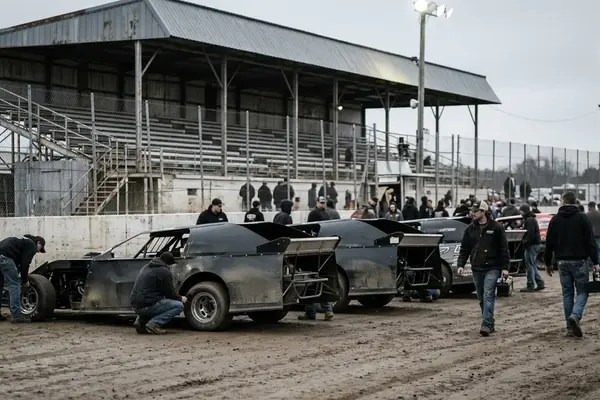
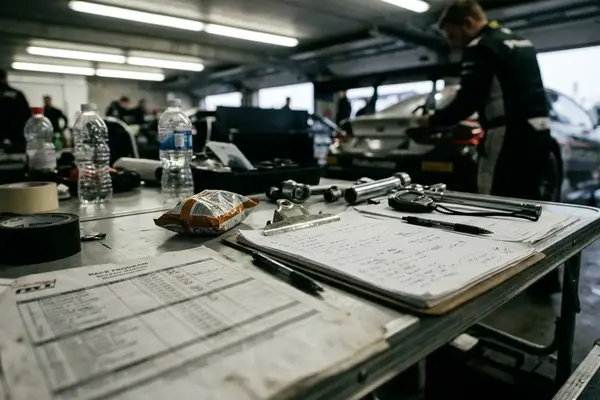
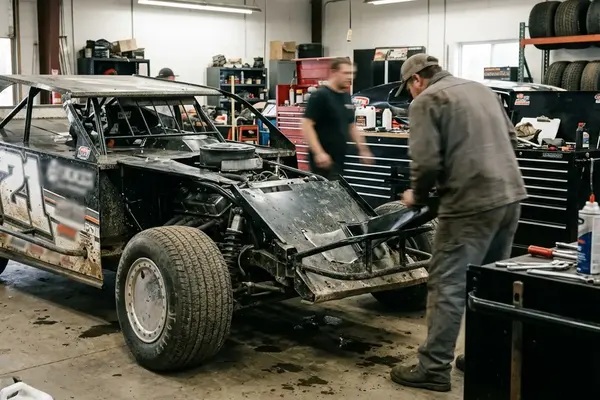
Consider a common inbox problem on a Monday morning. A race team submits a three-paragraph announcement celebrating their "relentless pursuit of excellence" and thanking six marketing partners, while burying the actual news—a broken rear panhard bar mount during Saturday's third heat race—in the final line. An editor on deadline must strip out every unsupported superlative before locating a single usable fact. Contrast that with a crew member who sends three clean bullets right from the trailer workbench:
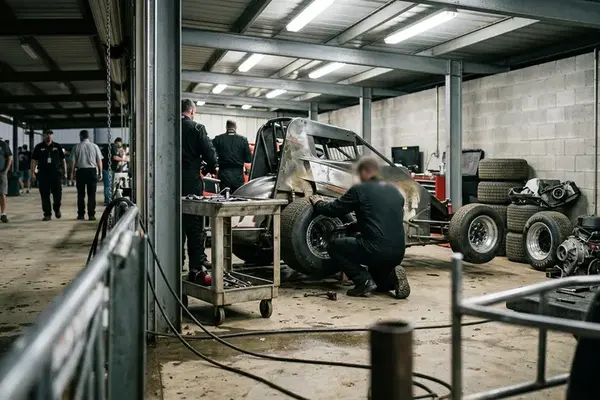
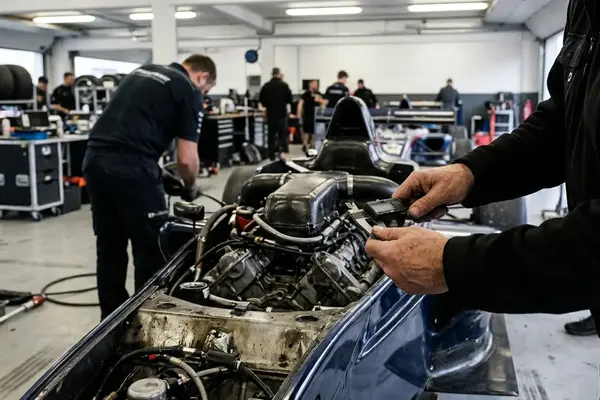
- The mechanical change and reason: Crew chief Mike Stevens replaced the rear panhard bar mount and switched to a backup Torsion bar configuration after contact with the outside wall in Heat 2 bent the primary right-rear assembly.
- The race date, track, division, and verified result: Saturday, May 18, Rolling Wheels Raceway Park, 358 Modified division; started 14th in the 30-lap feature and finished 6th.
- The next scheduled appearance: Confirmed entry for the upcoming Saturday night program at Fulton Speedway in the 358 Modified division.
That three-bullet structure requires zero translation. The editing decision on the desk is straightforward: remove unsupported promotional adjectives and retain attributable mechanical changes, official race results and standings, dates, and full names.
A useful mechanical sentence always identifies the specific component and the decision behind it, following a proven structure: [Crew chief] changed [component] after [observed problem]. Stating that the team "worked hard to make the car faster for the feature" gives the public address announcer nothing to say during hot laps. Stating that the crew swapped a gear set after the track slickened off during consolations gives both the website reader and the grandstand fan a real story that makes sense without opening a sponsor brochure.
Mandatory Driver, Car, and Division Details Every Release Needs
Every submission must identify the driver, car, and racing division or series at the very top of the email before launching into the news paragraph. Pit rosters across the Northeast frequently feature multiple drivers sharing a surname, identical car numbers separated only by a letter suffix, and teams that cross over between regional series on the same weekend. Matching your top-line identifiers to the relevant entry list or official results prevents misattribution.
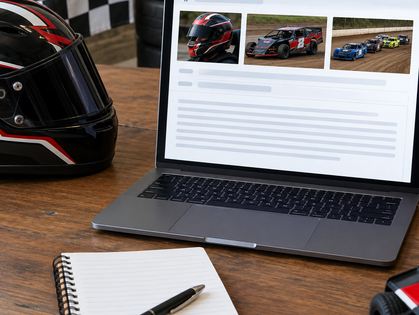
Place four baseline identifiers at the top of your note:
- Driver full name: Use the exact first and last name registered at the pit shack, avoiding nicknames unless they appear on the official entry list.
- Hometown: Include both the city or town and the state or province (for example, Waterloo, NY or St. Catharines, ON).
- Car number: Include any letter suffix or prefix exactly as scored by the timing and scoring tower (such as
21a,9s, or07). - Exact division: Write out the specific class listed for that event—such as Big Block Modified, 358 Modified, or Sportsman. For sprint-car coverage, reproduce the exact sanction or engine class shown on the entry list (for instance, 360 Sprint or 410 Sprint) rather than assuming that the word "Sprint" fully identifies the field.
Equipment specifications belong in the header or lead paragraph only when they directly explain the announcement. When a chassis or engine swap is central to the news, identify the configuration from the team's confirmed information, such as moving to a Bicknell chassis or installing a fresh 358 small-block engine. Never infer a chassis builder or engine builder solely from decals or sheet-metal appearance.
Integrating Sponsors and Crew Chiefs Into the Narrative
Sponsor recognition belongs inside the action of the story. Rather than pasting a vertical laundry list of around twenty contingency decals at the top of the email, attach sponsor names to the concrete contribution being reported. If a local machine shop helped expedite cylinder head repairs on Tuesday so the team could make the Friday night tow, or if a primary partner stepped up to fund a replacement engine for a holiday special, state that connection plainly. Similarly, identify the crew chief by full name on first reference directly beside the mechanical decision they made in the pit area.
Incomplete Submission vs. Press-Ready Race Team Update
The difference between an ignored email and a published story comes down to verifiable specifics. Compare how raw team notes look when they arrive incomplete versus when they are structured for immediate publication:
| Submission Field | Incomplete Driver Submission | Press-Ready Format |
|---|---|---|
| Driver Identification | "We had a good run Saturday night in the 358." | "[Full name], of [hometown, state/province], drove the No. [number and suffix] in the [exact division] at [track] on [date]." |
| Mechanical Context | "The guys thrashed in the pits after the heat and fixed the front end." | "Crew chief [Full name] replaced the bent right-front spindle after lap-four contact in the second heat race." |
| Sponsor Credit | "Huge thanks to all our amazing sponsors for making this season possible!" | "Primary partner [Sponsor Name] backed the mid-week engine refresh ahead of the upcoming [Track Name] twin-features program." |
| Next Appearance | "See everybody next weekend at the track!" | "The No. [number and suffix] team returns to competition on [date] at [track] for the [division] main event." |
Photo Specifications, File Formats, and Track Photographer Credits
A sharp, properly credited photograph elevates a brief team note into a featured item on a track website. Visual submissions require strict technical discipline so the media desk can process the file without hunting down missing clearances or rebuilding distorted layouts.
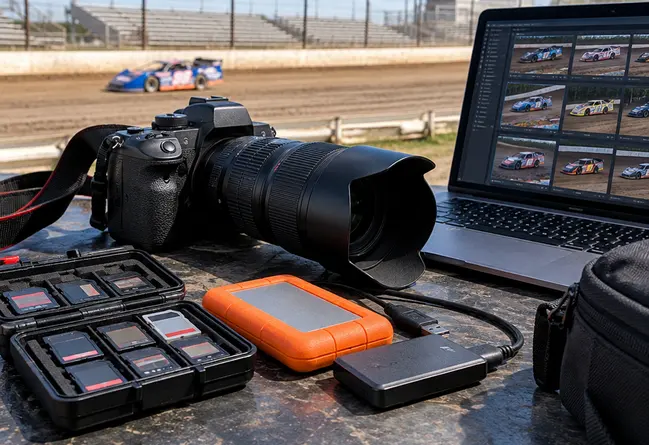
Follow these baseline technical standards when preparing an image for the PR inbox:
- Orientation and composition: Choose a clean horizontal (landscape) photograph that shows the subject and the car number clearly. Avoid vertical phone snapshots or heavily cropped frames where the car is cut off.
- Unaltered image quality: Supply the original-resolution image in JPEG or PNG format. Strip away heavy social media filters, text overlays, or baked-in decorative graphic borders, and never send a low-resolution screenshot or a repeatedly compressed social download.
- Separate file attachment: Attach the image file directly to the email rather than embedding it inside a Microsoft Word document or a PDF. Embedded images require extra extraction steps and frequently degrade the usable original file.
- Standardized filename: Rename the image file before attaching it, using the exact pattern
CarNumber_DriverLastName_Track_YYYY-MM-DD.jpgand preserving any letter suffixes in the car number (for example,21a_Miller_RollingWheels_2025-06-14.jpg).
Copyright Clearance and Caption Requirements
A filename and a photo credit line identify the attachment and its creator, whereas only the photographer's explicit permission establishes the legal right to publish the image. Dirt-track photographers work long hours along dusty fences and inside hazardous infield corners to make their living. Saving a proof from a photographer's social media feed or website does not grant a license to redistribute it to a PR desk.
Secure Written Photographer Clearance: Always obtain explicit publication permission—such as written confirmation covering the intended track or series website release—before attaching a photograph. Include both the photographer's full name and the permission basis directly in your email caption, alongside the driver's name, car number, track, and date.
Timing Your Submission Around the Northeast Dirt Track Weekly Schedule
Understanding the weekly rhythm of a Northeast dirt-track media desk ensures your news arrives when editors are actively building pages rather than when they are packing gear bags for the speedway. The specifications and weekly windows outlined here serve as a recommended team workflow to align your updates with standard production habits, as individual track desks maintain their own internal schedules and placement priorities.
Weekly digests have to fit race results and the next race previews into the gap between scheduled programs.
- Sunday (08:00–12:00) — Post-Race Recap Follow-Up: Ideal for Saturday night feature winners, hard-charger runs, or teams explaining an uncharacteristic DNF from the night before while editors compile weekend race results and standings.
- Monday, Resolving Scoring or Roster Discrepancies: Use Monday to contact scoring or PR staff calmly if an official result sheet omitted a car-number suffix, listed an incorrect hometown, or misidentified a substitute driver.
- Tuesday (08:00–11:00), Routine Team and Sponsor News: A good window for mid-week driver updates, new chassis debuts, crew additions, and sponsor announcements.
- Wednesday (12:00 Noon), Internal Advance Cutoff: Treat Wednesday at noon as your team's firm internal deadline for submitting a complete advance package so it can be verified and folded into the weekly preview release and announcer notes.
- Thursday (13:00–16:00), Final Preview Checks: Reserved for brief confirmations, such as verifying that a repaired engine fired cleanly on the dyno and the car will make the haul for the weekend's events.
Handling Milestone Wins, Emergencies, and Friday Afternoon Notes
When a driver captures a career milestone win on race night, send a brief alert after the checkered flag, explicitly marking the result as provisional until the official post-race technical inspection and scoring classification confirm it. Verify the claimed milestone against historical track records before presenting a career win count as established fact.
Separate urgent operational issues from publicity. If an immediate safety concern arises in the pit area or on the grounds, report it directly through track officials or emergency response channels first; never treat a media or PR email inbox as an emergency-response channel.
Conversely, avoid sending non-urgent team news on a Friday afternoon. By Friday afternoon, track staff and media personnel are already on the speedway grounds setting up the press box, testing timing loops, and updating visitor information for traveling fans. A routine sponsor release sent at 3:30 PM on race day competes directly with race-day operations and will almost certainly sit unread until the following week.
How Announcements Move from the PR Inbox to the Published Track Update
When an email lands in the PR inbox, it enters a verification-first editorial sequence designed to keep erroneous claims off the website and out of the public address booth. Knowing how an editor processes your note helps you format the email so it survives every check intact.
- Sender and Date Identification: The editor confirms who sent the message, when the event occurred, and whether the contact person is authorized to speak for the race team.
- Pit Roster Cross-Check: Driver names, car numbers (including suffixes), and divisions are compared against the relevant official entry list or season registration log.
- Results and Points Verification: Any claimed finishing positions or championship points standings are checked against dated official records. Editors record the exact effective date of the standings and note whether those totals include the latest completed race; never rely on an undated points screenshot as current fact.
- Discrepancy Resolution: If a team note claims a third-place finish while the official scoring rundown shows fifth due to a post-race weight penalty, the editor uses the sender's phone number to clarify the discrepancy before publishing.
- Dual-Channel Formatting: Once verified, the single email is split into two distinct outputs: a detailed paragraph for the website news feed and a condensed prompt for the track announcer's tower clipboard.
The car number and division must survive the move from your initial mechanical report to both the published website advance and the PA tower sheet. While the website version retains the full result, mechanical explanation, next appearance, and photo caption, the PA announcer's sheet strips the story down to the essentials needed while cars are rolling onto the banking: driver full name, phonetic pronunciation guidance, hometown, car number, division, and one concise news sentence.
Subject Line Conventions for Fast Triage
Clear subject lines allow volunteer track correspondents and PR directors to sort incoming mail instantly. Use standardized pipe-separated headers so your message never gets buried under generic subjects like "Press Release" or "News":
- Routine team news:
TEAM UPDATE | [division] | #[number] [driver] | [race date] - Track schedule adjustments:
SCHEDULE CHANGE | [track] | [date] - Roster or driver swaps:
ENTRY CHANGE | [division] | #[number] | [date]
When submitting a time-sensitive schedule or entry change, always identify the responsible track official or authorized team contact directly inside the body of the message. Keep the sender's mobile phone number in the editorial contact footer so staff can verify details from the pit tower without accidentally pasting a personal cell number into the public web copy.
Copy-and-Send Email Template for Race Teams and Track Volunteers
Drivers, crew chiefs, and family volunteers do not need public relations software to get consistent coverage. Copy the plain-text template below into your email client, replace the bracketed fields with your verified team information, and attach a single properly named horizontal photograph.
Subject: TEAM UPDATE | [Exact Division] | #[Number & Suffix] [Driver Full Name] | [Race Date YYYY-MM-DD]

1. IDENTITY: [Driver Full Name] (Pronunciation: [Phonetic Guide]), of [Hometown, State/Province], Car #[Number & Suffix], competing in the [Exact Division / Series Class].
2. DATED NEWS: On [Day, Date] at [Track Name], the #[Number & Suffix] started [X] and finished [Y] [note if official or provisional] in the [Lap Count]-lap [Division] feature; current points standing is [Position] as of [Effective Date of Official Standings, noting if latest race is included].
3. MECHANICAL & CREDITS: Crew chief [Crew Chief Full Name] changed [specific component/chassis/engine detail] after [observed on-track or shop problem], with [Sponsor Name] supporting [specific contribution, e.g., replacement parts / travel / engine refresh].
4. NEXT APPEARANCE: The team's next confirmed event is [Day, Date] at [Track Name] in the [Exact Division] (Single-sentence PA announcer brief: [One verified sentence summarizing the mechanical change or milestone for tower use]).
5. EDITORIAL CONTACT & PHOTO PERMISSION: Submitted by [Contact Full Name, Role], reachable in the pits at [Mobile Phone Number - For Editorial Verification Only, Do Not Publish]. Attached file [CarNumber_DriverLastName_Track_YYYY-MM-DD.jpg] shows [Driver Name] at [Track Name] on [Date]; photo by [Photographer Full Name], attached with written permission from the photographer for track and series website publication.
Pre-Send Pit Verification Checklist
Before hitting send, run through seven quick checks against your official pit paperwork:
- Car-number suffixes: Confirm that letters (such as
3bvs.3) match the transponder registration log and appear in both the text and image filename. - Division wording: Verify that the class name matches the speedway's official program (such as 358 Modified or Sportsman).
- Result status: Label race-night results as provisional if post-race tech or official scoring sheets have not yet been posted.
- Next-race date: Double-check the calendar date and track name against the official event schedule.
- Photographer credit: Ensure the shooter's full first and last name are spelled accurately in the caption line.
- Publication permission: Confirm you hold explicit permission from the photographer covering website use before attaching the file.
- Contact mobile number: Make sure the listed pit contact will have their phone charged and accessible on race day for quick follow-up questions.
A single, verified five-line email submitted before Wednesday at 12:00 noon gives the media desk everything required to place your team's update on both the published advance web release and the public address announcer's tower clipboard before hot laps begin.