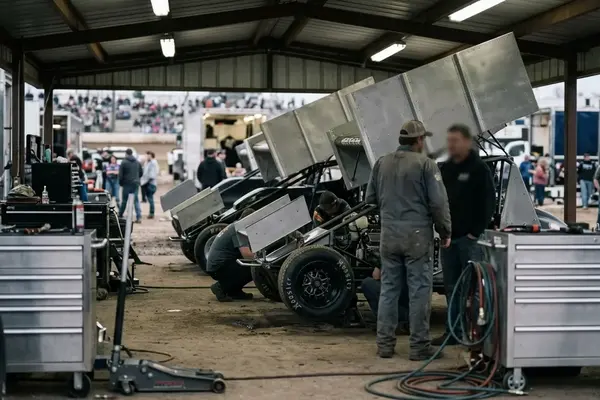
Walk the top row of any Central New York dirt track on a warm Saturday and you can read the crowd's age in about thirty seconds. The regulars are there. The coolers, the scanners, the folks who can name every 358-Modified in the pits by engine note alone. What's thinner than it used to be is the row of kids swinging their legs off the bench, bored between heats, waiting for a reason to come back.
What Thin Crowds Cost Before Anyone Notices
The racing product is doing its job. Sprint cars still lift the hair on your arms coming off turn two. The problem sits in everything wrapped around something like forty minutes of green-flag action: the parking lot, the walk, the restroom line, the wait for a hot dog at 8:40 when the feature is being called.
Here's the exercise that changes how promoters see their own property. Stop judging the night by the program and judge it by the family's path from arrival to departure. Start at the parking entrance. Follow the stroller route to the ticket window, then to the grandstands, then to the restrooms, then to concessions, then back out after the final feature. Rank the friction points by safety impact and by minutes stolen away from the racing.
Do that walk on two live race nights, not on a quiet Tuesday with the lights off. Cover the window from 90 minutes before the first scheduled green flag through 30 minutes after the last feature. That's when the real bottlenecks show themselves.
Walk The Whole Night
Total attendance will not tell you whether families came back. If you sell family tickets or household packages, compare redemptions across the first four to six race nights and count repeat purchases separately. A big crowd on a World of Outlaws night can hide a year of quiet family churn.
Lighting, Walkways and the Line Between Fan Space and Race Space
Compare two tracks with identical car counts and identical purses. One has a compacted, well-lit path from the main gate to the grandstand; the other has a rutted dirt strip that turns into shin-deep shadow after dark. The second track isn't losing fans over racing quality. It's losing them over a stroller wheel caught in a rut at 10:15 p.m.
Map the routes first: main gate to grandstand, grandstand to restroom, grandstand to concession. Inspect each one in daylight, then walk it again between 9:00 and 11:00 p.m., when glare from the infield lights, hard shadows and surface changes all stack up against you. Paving or compacting the busiest public routes and aiming light downward in common areas does more for a family's night than any promotion you could print.
Accessibility standards are worth reading straight from the source rather than guessing at them; the ADA guidelines for sports facilities lay out route width, surface and seating expectations in plain terms.
Timing matters as much as surfacing. Slot supplemental activities before hot laps or inside a planned 10- to 20-minute track-preparation interval. Never during heat races. Never during a feature. A parent shouldn't have to choose between a kids' activity and watching the 358-Modified main.
Guard The Operational Edge
Every family amenity belongs on the spectator side of the boundary formed by pit traffic, emergency lanes, race-control sightlines and the live program. Public-area upgrades should never sanitize the racing environment. The dust, the noise and the sight of a car sliding sideways are the product.
Why The Concession Fix Starts With A Stopwatch, Not A Menu
Most tracks reach for the menu first. Add a wrap, add a salad, add a vegetarian option, print new boards. Then the line gets slower because the kitchen is now assembling six things it never assembled before, and parents still miss the start of the feature.
Flip the order. Time at least 20 consecutive transactions during the 30 minutes before the first feature, recording three moments for each: order placed, payment completed, food handed over. The items that stall the line will announce themselves within about a dozen orders.
Then build a short family-combo menu from food that can be portioned before the rush. Limit the express offer to three or four clearly posted combinations, include one meat-free choice, and keep ingredient and allergen information available at the window. Stage the packaged components 15 to 25 minutes ahead of the expected surge. Open a separate pickup point only once the kitchen can run standard orders and express orders without the two crossing paths.
A sample of twenty transactions across two nights describes only those two nights. A rain delay, a double-feature card or a marquee touring show will skew the numbers badly, so re-time once the schedule settles into its normal rhythm.
Seating finishes the job. Put tables at least 20 feet back from the concession queue, and keep a continuous route between the service window, the seating and the grandstands wide enough for strollers and mobility devices.
The Fenced Play Enclosure Near The Main Gate
A kids' zone is chosen by tracing hazards before it's chosen by activities. Look at vehicle movement, spectator flow and raceway hazards, then fence a flat site near the main gate with one controlled entrance. Assign attendants. Post capacity and age rules where parents can read them without asking.
Install low-maintenance dirt-themed play features first. A retired chassis is a wonderful centerpiece for photos and for a six-year-old gripping a steering wheel for the first time, but it goes in only after sharp edges, fluids and loose panels are dealt with.
- Open from gate opening until heat racing starts, then reopen under supervision during a scheduled 10- to 20-minute track-prep break.
- Run driver meet-and-greets in 10- to 15-minute blocks before hot laps, with a queue that never blocks ticket scanning, emergency access or the pit entrance.
- Inspect fencing, gate latches, ground conditions and the chassis before every single opening.
- Close the zone the moment cars are moving nearby or supervision ends.
These spaces do quiet work. A kid somewhere around eight years old who sat in a real chassis is the fan buying pit passes at twenty-two, give or take.
A Thirteen-Week Off-Season Sequence You Can Copy
Weeks 1 through 3: map smoking areas, alcohol service, pedestrian routes and available flat ground. Pick one contiguous grandstand block for a signed, no-smoking, alcohol-free Family Section, and post those rules at the section entrance, the ticket window and the online seat-selection page.
Weeks 4 through 6: concession staff test three or four kid-friendly combinations, choose a dedicated express pickup point and confirm orders can be staged without tangling the standard line. Remaining weeks cover procurement, installation and staff rehearsal, then a two-race controlled launch and a review before the third event.
Three Choke Points To Measure
Grandstand conduct in the Family Section, kid-combo handoff time, and control of the 20-by-25-foot play enclosure. Everything else is decoration until those three hold up.
One Saturday, Fully Worked
Say your gates open at 5:00 p.m. for a 358-Modified show, hot laps at 6:30, first feature around 8:45. Here's the night on paper. At 4:45 attendants inspect the 20-by-25-foot fenced zone on the flat ground inside the main gate, clear of emergency, pit-vehicle and concession-delivery routes, and it opens with the gates at 5:00. From 5:45 to 6:15 you run two 15-minute driver meet-and-greet blocks beside the zone, queue running parallel to the fence so ticket scanning stays clear. At 6:00 the kid-combo express lane opens with four posted combos, one meat-free, components staged since 5:40. The zone closes at 6:30 for hot laps. The Family Section, signed at the stair entrance, fills through the heats. At roughly 7:50, during a 15-minute track-prep break, attendants reopen the enclosure for a second supervised window. The express lane shuts when the feature is called at 8:45. Two race nights later, you compare handoff times against your baseline twenty transactions, adjust the lane's open window, and set the pattern for the season.