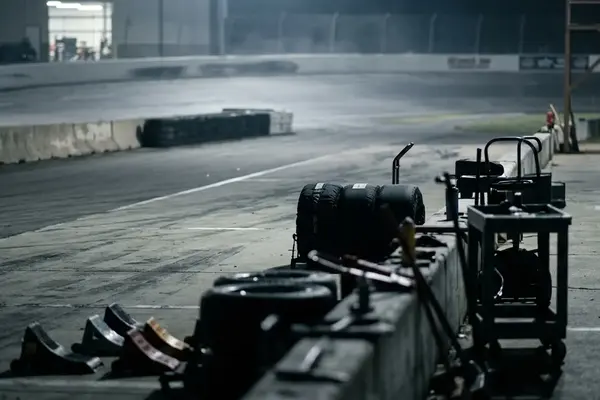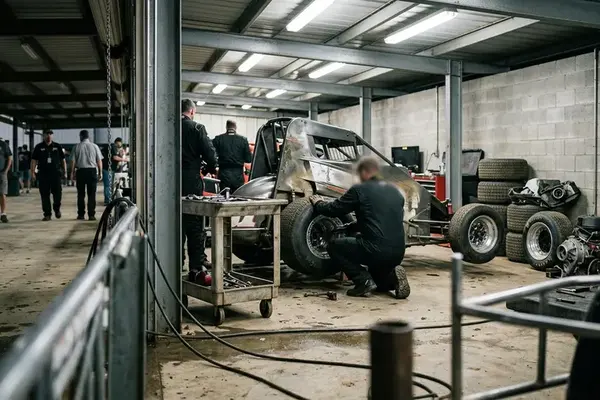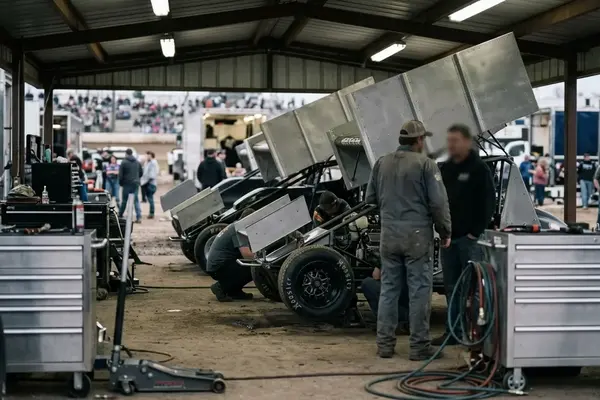
Anyone who has walked the back side of the pit area at Rolling Wheels Raceway Park across three consecutive seasons has seen the same picture change twice. A pit that looks packed on a July Saturday can still push a thin feature field to the staging line, while a quieter-looking night off Route 5 sends a full complement of 358-Modifieds to the scales. The eye is a poor instrument here. The sign-in sheet is a better one.
Reading the Gate: Entered Cars Against Everything Else in the Pits
Promoters who survive about a decade of Northeast dirt programming share one habit: they separate what was visibly occupied from what was actually recorded. Four records get pulled after every completed show — cars signed into each division, paid grandstand scans, pit-pass sales, and seating by section. Those four are then mapped against the advertised lineup.
That mapping exposes the two failure modes that quietly drain a season. The first is a crowded pit area that never converts into spectator demand. The second is strong grandstand attendance that rests entirely on one premier class, which means the card collapses the moment that class tours elsewhere.
The technical distinction matters more than most weekly programs admit. Total pit population counts drivers, crew members, officials, and guests. Entered cars by division counts the machines that can actually take a green flag. A team hauling five crew inflates the pit gate without adding a starter, so the two figures must be logged on separate lines and never averaged together.
Comparison discipline is the other half. Placing an April opener beside an August program produces noise, not signal. The workable method compares equivalent portions of successive schedules — the first six completed race nights of 2022 against the first six of 2023 and 2024, same seasonal window, same weather exposure.
Which Classes Genuinely Fill the Staging Line
Division mix is settled by ledger work, not by preference. After each completed program the promoter logs entries by class, heat-race count, feature starters, paid pit admissions, paid grandstand admissions, weather conditions, and any competing regional schedules running that night. Nothing exotic. Just the same eight fields, every week, in the same order.
Before the next schedule is drafted, each division is reviewed over a rolling block of completed dates rather than a single result. A four-to-six race window smooths the outliers. Cancellations stay outside the denominator so a washed-out night cannot depress a class average, though the cancellation itself remains in the weather record where it belongs.
The review runs twice per season. Once after the opening six completed dates, when equipment is fresh and optimism is high, and again during the final four scheduled weeks, when repair backlogs and depleted tire inventories have thinned the available car pool. A class that holds its entry count at both checkpoints has earned a weekly slot. A class that posts twenty cars in May and nine in September is a rotation candidate.
Booking a premier touring series follows a different calculation. The date is committed when the expected gate and regional draw can carry the purse, and local support classes are built around it so the program still functions if the tour's car count underdelivers.
Rain-Skewed Fields
Early-season rain, cold track conditions, and late-season mechanical attrition all distort one-night totals. A single enormous field or a single embarrassing one should never determine the following season's class roster. Rolling averages exist precisely because dirt racing weather refuses to cooperate.
Where the Record Has Gaps
Honesty about the instrument is part of the method. Scan totals miss comped tickets, promotional passes, and children admitted free, and a rain-shortened program leaves a partial concession record that cannot be compared cleanly against a completed twelve-event card. The trend across a rolling window still holds up. Any single line item deserves a second look before a division gets cut.
Tow Money, Tires, and the Real Cost of Showing Up
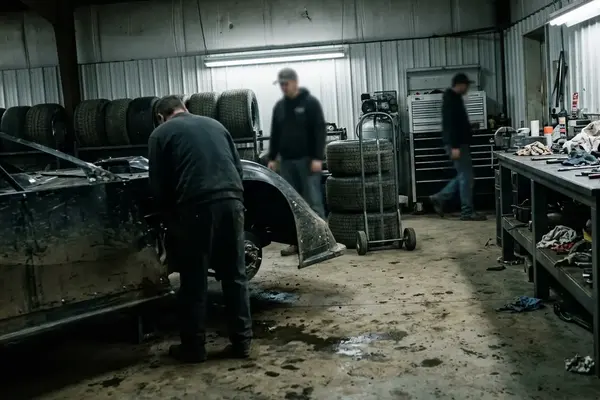
Roster adjustments start with the money a team spends before it earns a dollar of purse: round-trip towing, fuel for both the hauler and the race car, tires, routine chassis service, and repair after contact. Those costs are structural. A driver does not decide to skip a Saturday because of enthusiasm; the decision gets made in the shop on Thursday when a bent front end meets a thin checking account.
Travel exposure can be measured without guesswork. Record each entrant's home ZIP-code region and sort the round trips into three bands: under 100 miles, 100 to 199 miles, and 200 miles or more. Car count alone tells a promoter nothing about tow burden. A field of eighteen drawn entirely from inside the first band behaves very differently from eighteen scattered across all three.
Those burdens then get set against pit admission cost, purse distribution, and the number of on-track opportunities each class actually receives across a night. A division running one heat and a fifteen-lap feature is asking a team to absorb a full tow for eight minutes of competition.
Fan economics run on a parallel track. Ticket scans and concession transactions are reviewed together, because a program that stretches past a reasonable hour costs the grandstand in food sales and costs the promoter in return visits. Before altering a weekly roster for the coming season, the practical review covers purse position, pit-pass revenue, tire rules, and average program completion time across the May-through-September windows of the two prior seasons.
Where the entry ledger shows a support class bleeding cars while its tow-band distribution widens, consolidation usually beats a purse increase. Combining two thin classes into one competitive field raises car count, shortens the program, and puts more money in front of fewer starts.
The 90-to-150-Mile Calendar Problem
No Central New York track schedules in isolation. Schedule review begins with a regional calendar organized by race night and eligible division, built out to a driving radius of roughly 90 to 150 miles. Inside that radius, a competitive 358-Modified team can realistically choose between two shows.
Friday programs and Saturday programs get audited separately, and eligibility is defined by rules compatibility — engine, tire, and body specifications close enough that the same car can run both places without modification. Two tracks advertising the same class on the same night, with one posting a larger purse or a better points opportunity, will split a field that neither venue can afford to split.
Timing the audit is its own discipline. The first conflict check belongs between October and December, before contracts and rule packages are locked. A second pass runs 21 to 30 days ahead of each race, once postponements and makeup dates have started rewriting the regional calendar in real time.
Contact with neighboring schedulers before anything is finalized produces the cleaner outcome. Cooperation can place the same division on different nights or alternating weeks, which keeps cars circulating through the region instead of concentrating them at one gate and starving another. Counter-programming works too, when it is deliberate: booking a distinctly different headline class against a neighbor's touring date rather than fighting for the same haulers.
Rebuilding the Weekly Card at Three Checkpoints

The final lineup emerges from crossing three records: rolling entries by division, paid spectator demand, and the direct cost of presenting each class. Divisions with stable fields and competitive heat races become the weekly core. Volatile classes rotate onto selected dates. A premier class lands where its purse and likely audience fit the budget, not wherever tradition put it last year.
Three in-season checkpoints keep the card honest: after the third completed race, at the midpoint of a 12-to-18-date schedule, and four weeks before the final scheduled program. At each one, the same figures come off the sheet — entries per class, number of heats, feature starters, paid grandstand scans, paid pit admissions, advertised purse, first green-flag time, and final checkered-flag time.
Core Versus Rotation
A division earns weekly status by holding entries and heat depth across a full rolling window. Everything else belongs on a rotation, where a strong single night is a bonus and a weak one costs nothing structurally.
Static year-over-year scheduling assumes the region stands still. It does not. Tow costs move, neighboring tracks change their nights, and a support class can lose close to a third of its cars over one winter without a single warning sign in the previous September's totals.
So here is the question that actually decides which gate gets your money on a Saturday night off Route 5: a monster car count stacked into one premier division, or a diverse card of local classes where every heat race is a fight to the line?