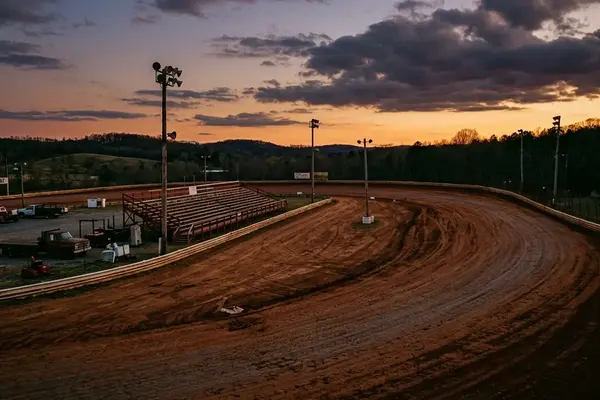
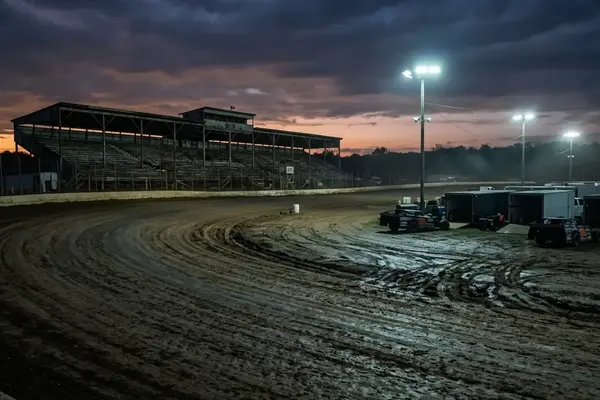
August 17, 1969. That's the date everything starts at Rolling Wheels Raceway Park, and it's the cleanest place to begin any honest telling of this story.
When the gates first opened off Route 5, Central New York gained more than another stretch of clay. It gained a venue that would help define dirt-track racing across the Northeast for decades. From the very first night, the identity was clear: this was a place built for dirt competition, and especially for Modified racing. That focus never wavered. It only deepened.
I've spent enough race weekends in operations to know the difference between a track that drifts into its character and one that arrives with it. Rolling Wheels arrived with it. The chronology that follows — a founding vision, a promotional revolution, a roll call of record-setters, and a memorial that keeps the founder's name alive, all of it traces back to that August evening.
The Dawn of a Dirt Track Legend
Some tracks earn their reputation slowly. Rolling Wheels did not have that luxury, and frankly, it didn't need it.
The location mattered from day one. Sitting in Central New York, the raceway plugged directly into a region that already breathed motorsports. Fans here knew their Modifieds. They knew the smell of methanol and the particular hush before a green flag drops over a packed clay surface. So when Rolling Wheels opened in 1969, it wasn't introducing dirt racing to strangers — it was giving a passionate community a new home.
That regional relevance is the thread to hold onto. The track's significance was never purely local. It reached into the broader Northeast scene, the corridor where dirt-track racing has always run hottest. Understanding that geography is the key to understanding why the next fifty-plus years unfolded the way they did.
Bob Petrocci's Vision and Track Design
Before any promoter put a stamp on Rolling Wheels, Bob Petrocci put down its bones.
Petrocci founded the track and designed it. That ordering matters, because the racing character we celebrate today came from his hand long before anyone else touched the operation. He didn't build a blank canvas and hope a personality would emerge. He built for a purpose.
Built for the Modifieds
The primary division written into the track's identity from the start was the Big-Block Modifieds. Anyone who has stood trackside knows why that choice shapes everything. Big-Blocks demand a layout that rewards speed and lets cars run side by side without forcing single-file processions. Petrocci's design aimed squarely at that — a dirt surface built for high-speed, competitive Modified racing where passing was a genuine possibility, not a once-a-night miracle.
I'll be careful here. The specific numbers — exact length, banking degrees, seating capacity, are details I won't pretend to quote without a verified spec sheet in front of me. What I can say plainly is the intent behind the layout: competitive, fast, and unmistakably built for the Modifieds that would become its signature.
The founder's fingerprints are on the racing itself. Petrocci didn't just open a track; he set the competitive temperament that later promoters inherited.
Glenn Donnelly and the DIRT Motorsports Era
If Petrocci gave Rolling Wheels its body, the next phase gave it organizational muscle.
In 1976, Glenn Donnelly established DIRT Motorsports, and his influence on the facility belongs to the track's second major chapter — the era of organizational control, sharp promotion, and a structured framework around Northeast dirt racing. Donnelly stepped in as track owner and one of the most influential promoters the region has known. Under his stewardship, Rolling Wheels stopped being simply a place to race and became part of a larger competitive system.
The Pivot to Specials-Only
Here's the decision that separates Rolling Wheels from the pack, and it's the one people most often get wrong.
After 1982, the track shifted to a Specials-only race format used throughout the season. This is not a footnote. The calendar stopped revolving around a standard weekly program and started building itself around special events. If you describe Rolling Wheels as a generic weekly short track across its whole history, you've missed the defining operational model of its modern identity.
What matters: After 1982, Rolling Wheels was a Specials track. Big shows, marquee nights, events drivers and fans circled on the calendar — that became the model, and it's central to why the venue carries the weight it does.
From an operations standpoint, this changes the entire rhythm of a season. You're not managing the steady cadence of weekly points racing. You're building toward peaks, each one a production in its own right. That demands different planning, different staffing, different energy. And it's exactly what made Rolling Wheels feel like an occasion rather than a routine.
Record-Setting Drivers and Racing Divisions
Legacies live in the record books, so the verified numbers matter.
The headline belongs to the Modifieds, as it should. Will Cagle stands as the all-time Modified feature win leader with 70 victories. Seventy. In the division that defines the track, that figure is the closest thing to a competitive monument Rolling Wheels has. Cagle's name and that number anchor the entire racing legacy.
Divisions Across the Eras
One thing I'd stress to anyone studying the track's history: division records are tied to specific eras. You can't blend them into one timeless list. They shift as the calendar moves.
- DIRT Late Model (1976–1981): Jack Emerson led this division with 8 feature wins during its active run.
- Pro Stock (1995–2005): Jipp Ortiz topped the era with 5 wins.
Beyond those, the 358-Modifieds earned their place in the mix, broadening the Modified family that always sat at the heart of the program. And there was the Street Stock division, which ran a brief stretch from 2004 to 2007 — short-lived, but part of the honest record of what raced here and when.
Record context: When you're comparing drivers and divisions, always pin the record to its window. Emerson's eight Late Model wins belong to the late '70s and early '80s. Ortiz's Pro Stock total belongs to the decade ending in 2005. Mixing eras flattens a history that's actually layered and specific.
That era-by-era discipline is what keeps the storytelling accurate. The Cagle Modified record sits above everything because the Modifieds were always the constant. The secondary divisions came, made their marks, and in some cases moved on.
The Robert N. Petrocci Memorial and Lasting Impact
History becomes memory when a community decides to honor it. At Rolling Wheels, that decision wears a name.
The Robert N. Petrocci Memorial stands as the annual highlight event, and it's the perfect bridge between documented history and living tradition. Naming the marquee race for the founder ties the present back to that 1969 origin and to the man who designed the place for competitive Modified racing in the first place. Every running of it is, in a sense, a thank-you note to where the whole story began.
Trace the through-line and the shape of the legacy comes into focus. The 1969 opening. Petrocci's founding role and his Modified-first design. The Donnelly-era DIRT influence beginning in 1976. The post-1982 turn to Specials-only racing. And the long arc of Modified records crowned by Cagle's 70 wins.
What does all of that add up to? A raceway that matters deeply to dirt-track drivers, crews, and fans across Central New York and the wider Northeast. Not because of any single night, but because of a continuity that few venues sustain. The community observation I'd offer, after years watching crowds file in along Route 5, is simple: people don't return to Rolling Wheels out of habit. They return because the place has always meant something.
That's the legacy. A founder's vision, a promoter's reinvention, a record book full of genuine talent, and a memorial that keeps the founder's name roaring through the Central New York night. From August 17, 1969 onward, Rolling Wheels Raceway Park has earned its standing in the dirt-track world the only way that lasts — by giving the racing community something worth coming back for.